
Toyota – Kaizen: Learning Every Day. How continuous improvement became a way of working, learning and thinking
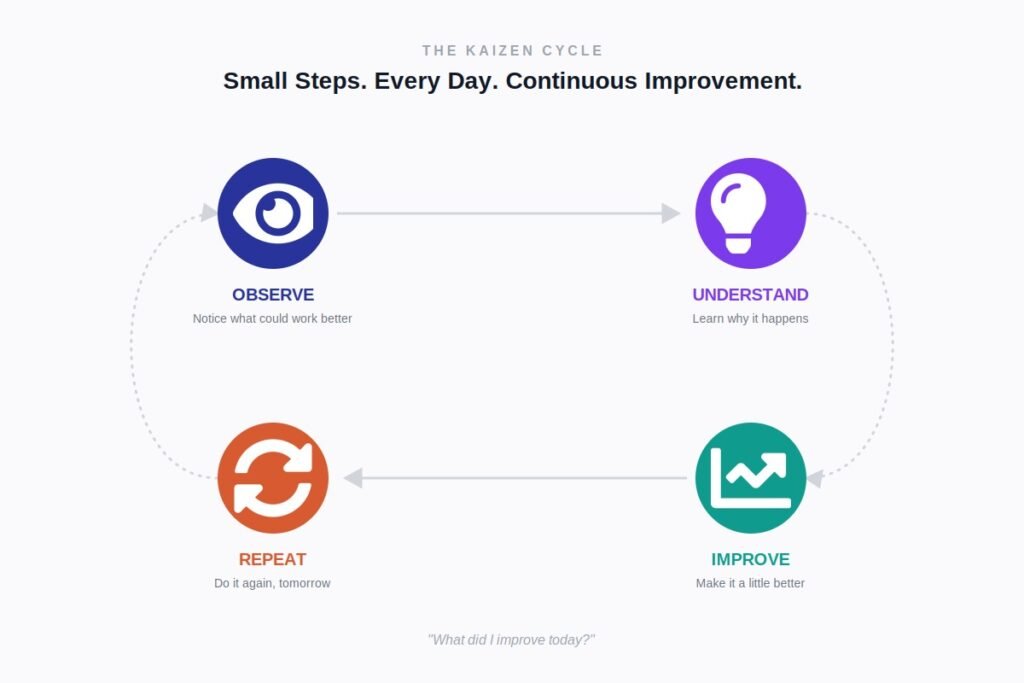
When people hear Kaizen, they often think about manufacturing, efficiency or reducing waste. Kaizen is a Japanese term that means “continuous improvement.” In simple terms, it means making small, regular improvements to work, processes, skills or performance every day. At Toyota, Kaizen is much broader than a manufacturing technique. It is a mindset—the belief that there is always a better way to do something. Toyota describes daily incremental Kaizen as something implemented by employees across the company, not as an isolated production technique.
The interesting part for Learning & Development is that Kaizen begins with a simple question: What can be improved today? It could be a production process, a customer interaction, a report, a workflow or even the way a task is learned and performed. Instead of waiting for a major training programme or a major transformation project, employees are encouraged to observe problems, understand their causes and make small improvements continuously.
Toyota has historically created systems to encourage employees to contribute these improvements. Its Creative Suggestion system, launched in 1951, invited employees to propose ideas for improvement. In 1973, Toyota reported receiving more than 250,000 suggestions from 43,000 employees, with more than 70% being adopted. One suggestion alone was reported to have saved the company the equivalent of the working time of 15 employees and at least ¥24 million annually.
This is where Kaizen becomes particularly relevant to employee learning. Learning does not always have to happen inside a classroom. An employee who identifies a recurring problem, studies why it happens, discusses it with colleagues and finds a better way of working is learning in action. Toyota’s approach connects problem-solving, knowledge sharing, experimentation and improvement rather than treating them as separate activities.
Toyota also places considerable importance on Genchi Genbutsu—going to the actual workplace and understanding what is really happening. The idea is simple: don’t improve a process based only on assumptions or reports; observe the work, understand the problem and learn from the people closest to it. Toyota continues to describe developing people who can think independently and implement Kaizen as an important part of its approach.
| Kaizen in the Workplace | |
| Traditional Learning Approach | Kaizen Approach |
| Training happens at scheduled intervals | Learning happens continuously |
| Trainer provides the solution | Employees help identify solutions |
| Focus on completing a programme | Focus on improving the work |
| Learning happens mainly in classrooms | Learning happens at the workplace |
| Improvement can be project-based | Improvement becomes everyday behaviour |
The business lesson is equally important. Continuous improvement can strengthen quality, efficiency, problem-solving and adaptability because employees are constantly looking for better ways of working. Toyota itself links the strength of its frontline operations with people who understand TPS, pursue Kaizen themselves and continue developing their skills.
For HR leaders and business heads, the question therefore isn’t simply, “How many training programmes did employees attend this year?” A more meaningful question could be: “What did employees learn, change or improve because of those learning experiences?” That shift moves L&D from training activity towards measurable workplace improvement.
The idea also works well beyond manufacturing. A sales team can improve its customer-conversion process. An HR team can simplify onboarding. A finance team can eliminate repetitive manual work. An IT team can improve incident resolution. A manager can change the way team knowledge is shared. In every case, the principle remains the same: observe, learn, improve and repeat.
The TECH SANG Perspective
At TECH SANG, we believe learning should not end when a training session ends. The real value of learning begins when knowledge is applied, tested and improved in the workplace. Toyota’s Kaizen philosophy offers a powerful reminder that continuous learning and continuous improvement can become one process.
Perhaps the most useful question for every professional is not “What did I learn this year?” but:
“What did I improve today?”
Because sometimes, staying ahead doesn’t require learning something completely new. It simply requires finding a better way to do what we already do.